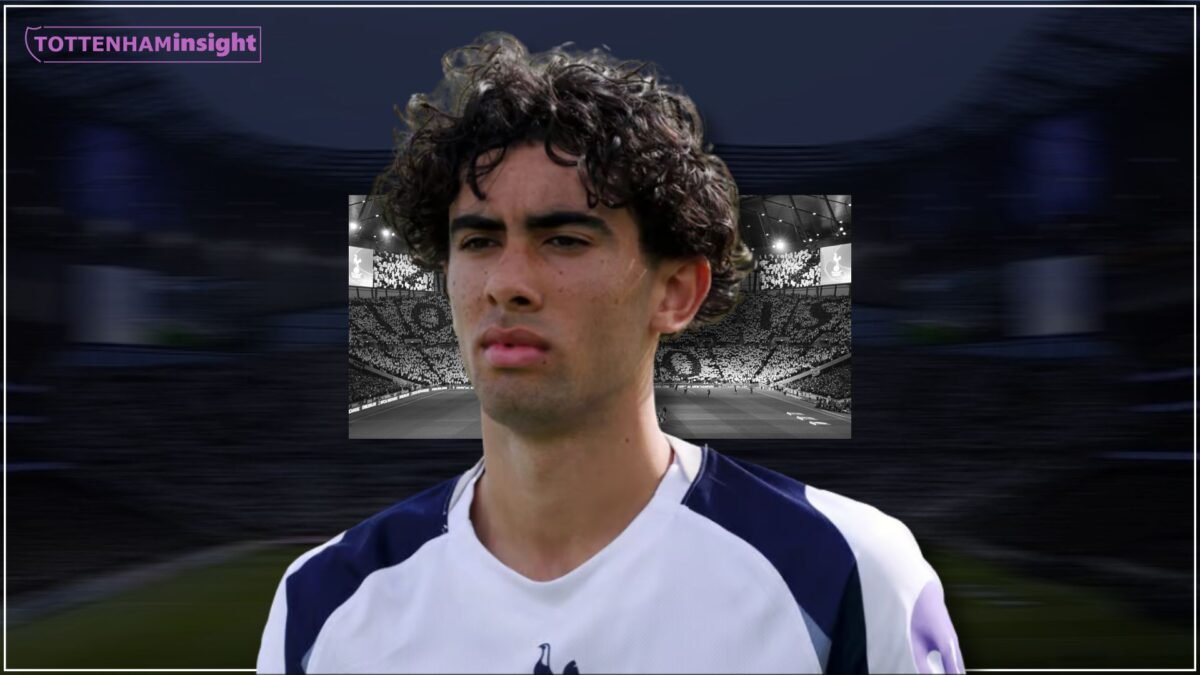
Luca Williams-Barnett needed barely five minutes of Premier League football to get Roberto De Zerbi, Steven Gerrard and half of N17 talking, so this is a good moment to take a proper look at the 18-year-old.
The academy prospect came off the bench in the 88th minute of Tottenham‘s 2-0 win over 10-man Crystal Palace on 31 October, beat two men down the left and crossed for a chance Mohammed Kudus should have buried. He was back in first-team training at Hotspur Way this week as Spurs got ready for Saturday’s trip to Leeds United.
De Zerbi has already called him “a very, very great talent”. Here is our Luca Williams-Barnett scouting report: where he came from, how he plays, what he still has to work on and where he fits.
Who is Luca Williams-Barnett?
Luca Williams-Barnett is an English attacking midfielder, born in Luton on 1 October 2008, so he turned 18 only a month ago. He is two-footed, stands 5ft 10in and can also play on the left wing or in central midfield.
He is registered with Tottenham’s Under-21s and trains with the first team, and he is an England Under-19 international with two goals in four caps at that level. He signed his first professional contract in October 2025, and Spurs were reported last month to have opened talks on a new deal, with Bayern Munich and Borussia Dortmund among the clubs keeping an eye on him.
Luca Williams-Barnett youth career and background
He started out at his hometown club, Luton Town, before moving into the Tottenham academy as a boy. The rise through the age groups was quick, and he was first named in a senior matchday squad at 16, under Ange Postecoglou in 2024-25.
His first-team debut followed on 24 September 2025, as an 87th-minute substitute in a 3-0 Carabao Cup win over Doncaster Rovers. That made him the 900th player to appear for the Spurs senior side, and he went into that night with six goals and four assists from six youth matches.
This season he went on the summer tour to Australia, got the last 12 minutes of the 5-1 League Cup win over Charlton Athletic in August, and then waited on the bench through most of the autumn before De Zerbi finally sent him on against Palace.
Luca Williams-Barnett style of play
The Palace cameo was a neat summary of what he does. Given the ball wide on the left, he didn’t look for the safe pass. He sat Anan Khalaili down, slipped away from Darío Osorio, beat Chris Richards to the byline and pulled the ball across the six-yard box. Then he turned to the South Stand and asked for more noise.
That is a direct, ball-carrying attacker who wants to go past people, rather than a playmaker who sits and recycles possession. He likes to start wide and drift into the half-space, and because he is comfortable on either foot, defenders can’t simply show him one way.
Ben Davies, who has seen plenty of young players come and go at Spurs, put it well on the summer tour. He said: “He’s a really top player. He’s got a lot of potential… to have a player like that who’s got no fear, that has the confidence to try things in games, who doesn’t get affected if he loses the ball, I think he’s got a bright future ahead of him.”
Strengths
- Dribbling in tight spaces. He beats people at close quarters, which is exactly what Spurs were missing against Palace’s packed defence.
- Two good feet. He can cut inside or go round the outside, which makes him hard to read.
- Personality. De Zerbi said in October: “Special talent. Special personality also. Because he’s arrogant, but arrogant good for football. Because you have to believe in yourself. Not forgetting to be humble.”
- Versatility. Left wing, the number 10 role or a more central midfield job, which gives his head coach options in a 4-2-3-1.
Weaknesses
The obvious one is physical. De Zerbi was open about it after a pre-season friendly in Sydney in July. He said: “We have to manage him like a precious diamond. We have to help him to improve in the last decision. Physically, work harder to become stronger because this time of football, he needs to be strong.”
That “last decision” line matters. He gets into good areas, but the final pass or shot is still the part being worked on, and Premier League full-backs will soon test whether he can ride a heavy challenge. The other gap is simply minutes: before the Manchester United game in October he had played only 65 minutes of Premier League 2 football this season.
Luca Williams-Barnett stats this season
The senior numbers are tiny, which is the whole point: this is a player at the very start of his career. Figures as of 5 November 2026.
| Competition | Appearances | Came on | Goals | Assists |
|---|---|---|---|---|
| League Cup | 1 | 78th minute vs Charlton Athletic (won 5-1) | 0 | 0 |
| Premier League | 1 | 88th minute vs Crystal Palace (won 2-0) | 0 | 0 |
Both times he replaced Mathys Tel. At international level, he has two goals in four caps for England’s Under-19s.
Luca Williams-Barnett potential and fit at Tottenham
In our view the fit is clearer than it was a month ago. Spurs have won three league games in a row, but they’ve been short of someone who can unpick a low block, and that is the one thing he does best.
His route in is from the left, or as cover in the number 10 role. With James Maddison’s minutes needing careful handling, and Mykhailo Mudryk and Savio out until after the international break, there are minutes to be had off the bench for a winger who isn’t scared to take a man on.
Gerrard has already compared him to Liverpool’s Rio Ngumoha, as we covered in his “one to watch” verdict. The ceiling looks high. The job now is to build the body and the decision-making without loading too much on an 18-year-old, which is the plan De Zerbi set out in the summer.
Is Williams-Barnett ready to start for Spurs?
Not yet, and that’s fine. Saturday’s lunchtime game at Elland Road will be physical, and we’d stick with the XI in our Tottenham predicted lineup vs Leeds United, with Williams-Barnett on the bench as a late option to run at tired legs.
Give him 15 or 20 minutes at a time through the winter and he could be pushing for a start by the spring. Five minutes against Palace showed he isn’t scared of this level. The next step is showing he can do it for longer.